
The questions to ask a dumpster rental company come down to nine things. They are sizes, prohibited materials, delivery lead time, swaps, placement, quote line items, weight, who answers the phone, and credentials. A good company can answer all nine on the first call for a San Antonio or Austin job. Use the list on anyone you’re considering, South Texas Dumpsters included.
It’s hard to judge a company’s answers if you haven’t worked out your own, and honestly that’s the first step in how to choose a dumpster rental company at all. Answer these four for yourself before you pick up the phone:
Those details change the call. A commercial build-out or tenant improvement in downtown San Antonio might fill several containers over a few weeks, so the swap plan matters about as much as the size. A roof tear-off on a north Austin house is a different job. It’s heavy debris over a day or two, and the container has to sit close to where the crew is tearing off. If you’re not sure about volume, our sizing guides for renovations and roof tear-offs walk through it.
Put these to every company you call. Some answers you’ll get in a sentence. Others need a follow-up, and how a company handles that follow-up is worth paying attention to.
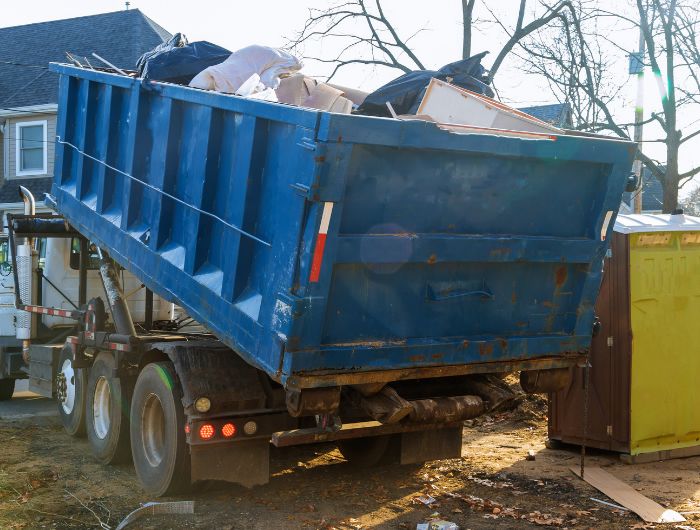
Not every company that takes your order owns a truck. Some dumpster rental sites are brokers: they book the job and hand it to whatever local hauler has room that week, which can work out fine but puts a middle layer between you and whoever controls your delivery date and your swaps.
So ask who owns the trucks and containers, and who you’ll actually talk to if the container doesn’t show. If the answer is a third party you’ve never heard of, you’re hiring them too, and you haven’t vetted them. On a commercial job with trades lined up behind each other, the handoff between broker and hauler is usually where a day gets lost.
A local operator gives you its own name and its own dispatch number, so the people answering your questions are the ones doing the work. Plenty of local companies still miss on the other eight questions, which is why it’s worth running all nine.
On a load of ordinary construction debris, credentials are a baseline check. They matter more on commercial and industrial jobs, and a lot more once special waste is involved. Responsibility for waste generally follows it from your site to the disposal facility. So if a hauler cuts corners, whoever generated the waste can end up pulled in, and on most jobs that’s the contractor or the property owner.
Ask for numbers, then check them. Our verification guide goes through each check in order, including what to do if a number doesn’t line up.
Here’s how we’d answer the list, so you’ve got something to compare other companies against.
We run 20, 30, and 40 yard roll-off dumpsters, all 22 feet long, and we’ll recommend a size once we know your debris and your site. If a container fills before you’re done, we swap it for an empty one in the same spot. We can often deliver same-day or next-day in our core service area, depending on routing. Call 210-372-8666 and we’ll tell you what this week looks like. We’re locally operated with no call center between you and dispatch, and we’ve been working San Antonio, Austin, and the surrounding South Texas area for over a decade.
For credentials, we hold EPA ID TXR000083663, Railroad Commission of Texas registration RN109046839, and an Industrial and Hazardous Waste transporter registration (SWR 96263). We also hold a contaminated soil hauling license from the Railroad Commission of Texas. For San Antonio and Bexar County work, we hold the Solid Waste Haulers Permit, City of San Antonio. The full list is on our permits and credentials page.
On industrial and special waste, we’re limited to Class 1 and Class 2 non-hazardous material. Anything classified above Class 2 needs a specialized hazardous waste hauler. For contaminated soil, you arrange the TCLP test and own the result, and once the material comes back classified as non-hazardous, we set up a waste profile and haul it to the correct landfill. The special waste management page has the rest of that process.

An ID, like an EPA ID, identifies a company in a regulatory system. A registration is a filing that puts the company on record with an agency for a type of activity. A license grants authority to do something specific, such as hauling contaminated soil. A permit is a city’s permission to collect or haul waste inside its limits. So when a company says it’s “licensed,” ask which of these it means, and get the number.
Local usually gives you more control on a San Antonio or Austin job, because the company you call is the one running the trucks. A national company can still work if it tells you up front who’ll actually haul the container.
Separate lines for the rental, delivery, and any weight overage, plus a note on what would change the total. If you get a single number, ask for the breakdown before comparing it against other quotes.
Call for a swap. The full container gets hauled off and an empty one goes in its place, billed as a new rental. On multi-week jobs, it helps to plan the swaps into the schedule from the start.
It depends on the company’s routing and your date. Same-day or next-day delivery is sometimes possible, but booking a few days out gives you more say over when the container arrives.
If you’re comparing dumpster rental companies for a job in San Antonio, Austin, or anywhere nearby, call 210-372-8666 and ask us everything on this list. We’ll go over what you’re hauling and where the container needs to sit, then put together a custom quote with the rental and delivery on separate lines.