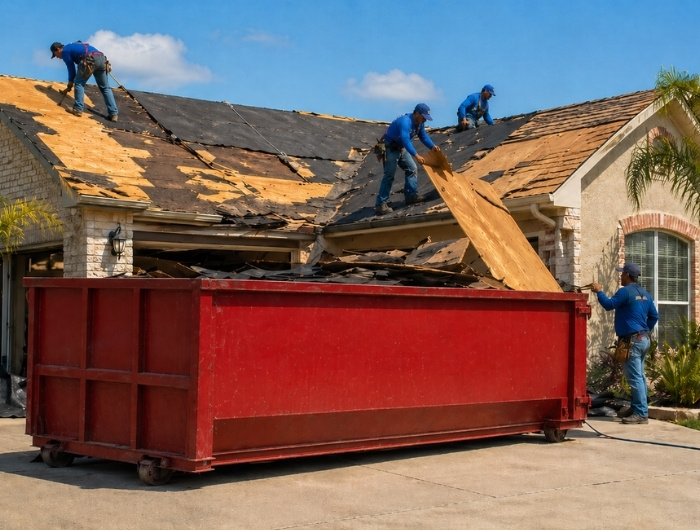
What dumpster size for a roof tear-off depends on which constraint binds first: volume or weight. A renovation fills a container by volume well before weight matters. A roof tear-off can go either way, and which one matters depends on what’s coming off the roof.
For most asphalt shingle tear-offs in San Antonio, Austin, and the Hill Country, volume still wins. A 30-yard roll-off fills at around 30 squares of single-layer architectural shingle, which is about 4.5 tons of debris. That’s well under the 10-ton DOT cap that applies to every roll-off on Texas roads.
The cap only becomes the binding limit on a narrower set of jobs: tile and slate roofs, premium designer shingles in larger containers, and tear-offs mixed with water-soaked decking debris.
For ordinary asphalt jobs, the size call comes down to how many squares are coming off and whether there’s a second layer underneath.
A square of asphalt shingles after tear-off takes roughly one cubic yard of volume in a roll-off, loose-loaded. A 30-yard holds about 30 squares of single-layer architectural shingle by volume. The weight of that load, at a typical 300 pounds per square, runs around 4.5 tons. The 10-ton DOT cap on Texas roads, set by Texas Transportation Code §621.101, is more than twice that figure. On a standard asphalt job, the cap doesn’t bind.
Shingle weight per square varies by material. Three-tab asphalt runs around 200 to 250 pounds per square, standard architectural runs 240 to 340, premium designer products climb toward 500 pounds, and concrete tile or slate sits at 800 or more. A double-layer tear-off roughly doubles the per-square figure. Water-soaked debris adds to the weight. So does decking debris when the underlayment comes off with the shingles.
For tile or slate roofs, the cap binds at about 25 squares, well before any standard container fills by volume. For premium designer shingles in a 40-yard container, weight and volume converge near 40 squares. Double-layer premium tear-offs hit the cap earlier than single-layer because the per-square weight roughly doubles. Tear-offs mixed with water-soaked decking debris can hit the cap on smaller jobs because of the load shift.
For everything else, which covers most residential asphalt reroofs and most small commercial work, the container fills by volume first. The 10-ton cap is a background constraint that doesn’t drive the size decision.

The active South Texas Dumpsters roll-off sizes are 20, 30, and 40 yard. Full dimensions and capacities are on the dumpster sizes hub page. For roofing specifically, the right pick is usually driven by square count, layer count, and what type of shingle is coming off.
A 20-yard handles most small residential reroofs of 15 to 20 squares. A 20-square single-layer architectural tear-off takes roughly 20 cubic yards by volume and runs about 3 tons by weight. Both numbers fit a 20-yard comfortably. The 20-yard is also easier to position on a residential property where space is tight, and the shorter side walls make ladder-height loading and tarped-chute loading simpler.
For 20 squares of double-layer architectural, volume becomes the tighter constraint. Each square of double-layer takes closer to 1.8 cubic yards by volume, so 20 squares runs about 36 cubic yards. That doesn’t fit a 20-yard by volume, even though the weight (around 6 tons) is still inside the 10-ton cap. Double-layer tear-offs of 15 to 20 squares usually need a 30-yard for volume reasons.
The 30-yard does most of the work in this bracket and is the most common roofing pick across the service area. A 25 to 30-square single-layer architectural tear-off lands in the 4 to 5 ton range and fits a 30-yard by volume with margin to spare on weight. Double-layer tear-offs change the math. A 30-yard holds about 15 to 17 squares of double-layer architectural by volume, so double-layer jobs above that range need either a 40-yard or a swap-out.
A 40-yard fits more squares than a 30-yard by volume. About 40 squares of single-layer architectural, give or take, depending on how tightly the debris loads in. For a 40 to 50-square single-layer asphalt reroof, a 40-yard handles the job in one drop at around 6 tons of debris weight. Premium designer shingles change this. At 500 pounds per square, a 40-yard hits both the volume cap and the weight cap at roughly 40 squares.
For 60-square jobs and larger, no single roll-off fits the volume regardless of which size is on order. Swap-out scheduling is required. Whether to run two 30-yards or two 40-yards on a swap-out basis is mostly an operational call: the 30-yard cycles back into service faster, the 40-yard takes fewer trips but holds the truck on site longer per container. For broader context on the construction line, the construction dumpsters service page walks through typical project scopes.
The maximum legal payload inside any roll-off container on Texas roads is 10 tons, regardless of container size. This is governed by Texas Transportation Code §621.101, which sets gross and axle weight limits for trucks operating on state highways. On most asphalt tear-offs, the cap doesn’t bind because volume fills the container first. On specific jobs, it does.
A worked example with the numbers. A 40-square single-layer architectural reroof at 300 pounds per square generates 12,000 pounds, or 6 tons. That’s well inside the cap, and a 40-yard handles it in one drop. The same job as a double-layer tear-off generates 24,000 pounds, or 12 tons, which exceeds the legal cap. Volume is also exceeded: a 40-yard only holds about 22 squares of double-layer by volume. Either way, a 40-square double-layer architectural job needs a swap-out.
The cap matters most on a few job types. Tile and slate roofs at 800 pounds per square hit the cap at roughly 25 squares, well before any standard container fills by volume. Premium designer shingles in a 40-yard container converge on the cap near 40 squares.
Tear-offs that include deteriorated decking, water-soaked underlayment, or significant flashing and metal debris can also hit the cap earlier than the shingle weight alone would suggest, because the heavier non-shingle material adds to the load without taking up much extra volume.
Volume drives the size decision on everything else. On a typical asphalt job, the 30 vs 40 yard question comes down to how many squares are coming off and whether there’s a second layer underneath. The 10-ton cap isn’t usually in the conversation.

A roofing tear-off doesn’t require the credential stack that industrial waste hauling does. The few that apply still matter. They confirm the debris can legally move off the site to a proper disposal facility, which keeps the property owner clear of downstream liability. The EPA-certified waste hauling in South Texas post walks through what each credential covers.
South Texas Dumpsters serves roofing contractors across San Antonio, Austin, and surrounding communities including Boerne, Kerrville, New Braunfels, San Marcos, and the Hill Country. We operate under EPA ID TXR000083663, the City of San Antonio Commercial Solid Waste Hauler Permit, and Railroad Commission of Texas registration RN109046839. The full credential list is on the permits page. For a roofing job quote based on square count, layer count, and turnaround, call (210) 372-8666.
A 30-yard holds about 25 to 35 squares of single-layer architectural shingle by volume, which lands the load weight in the 4 to 5 ton range, well under the 10-ton DOT cap. Double-layer tear-off takes roughly 1.8 cubic yards per square, so the practical limit drops to about 15 to 17 squares for double-layer. Volume is the binding constraint in both cases, not weight.
A 20-square single-layer architectural reroof fits a 20-yard by volume at around 3 tons of debris weight. A 20-square double-layer tear-off pushes past the 20-yard volume capacity (each square takes about 1.8 cubic yards in double-layer) and usually needs a 30-yard, even though the weight (around 6 tons) is still inside the 10-ton cap.
Three-tab asphalt shingles weigh around 200 to 250 pounds per square (100 square feet of coverage). Standard architectural or laminated shingles run heavier at roughly 240 to 340 pounds per square, with premium designer shingles climbing toward 500 pounds per square. Concrete tile and slate are significantly heavier, often exceeding 800 pounds per square.
The maximum legal load weight is 10 tons across all roll-off sizes in Texas, set by Texas Transportation Code §621.101. On most asphalt tear-offs, the cap is a background constraint that doesn’t drive the size decision because volume fills the container first. The cap matters most on tile and slate roofs (which hit the cap at about 25 squares), premium designer shingles in larger containers, and tear-offs that include water-soaked decking or significant non-shingle debris.
Same-day and next-day delivery is generally available across the South Texas Dumpsters service area when scheduling allows. For tight tear-off and dry-in windows, booking ahead by at least one business day is the safest way to lock in delivery timing, and swap-out scheduling for multi-load jobs is best confirmed during the initial quote.
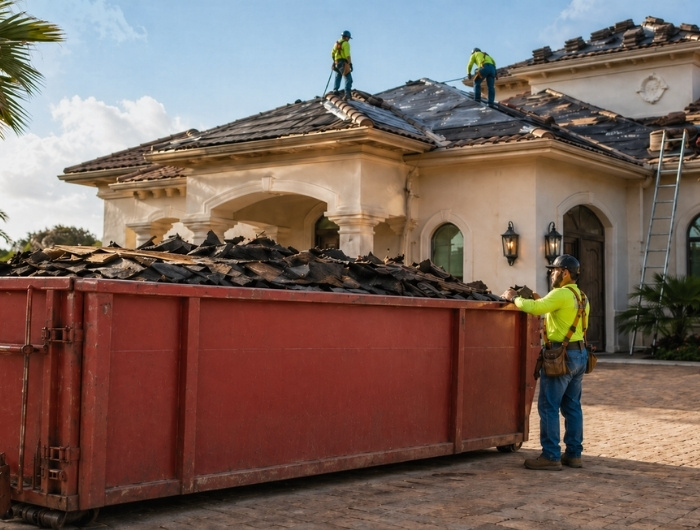
Sizing a roll-off for a roofing job comes down to square count, layer count, and what’s coming off the roof. The fastest way to land on the right container is to talk through the project with someone who knows the local debris streams.
Call (210) 372-8666 to discuss square count, layer count, delivery timing, and turnaround, or use the contact form for a custom quote.