


⚠️⚠️⚠️ SERVICE ALERT: Services will have a DELAYED start on Monday, January 26 due to inclement weather. This is to ensure the safety of our customers, our team members, & our community.
Weather permitting, we anticipate returning to normal operations on Tuesday, January 27. We are monitoring the weather and will be update this website as new information becomes available.

Construction Dumpster Rental in San Antonio and Austin

Sized to the phase you are in, swapped before a full container stops a trade, and hauled by a carrier that is registered for what comes off your site.

Your build generates debris on a schedule, and the container has to keep up with it. South Texas Dumpsters puts 20, 30, and 40 yard roll-off containers on commercial build-outs, tenant improvements, ground-up construction, and demolition sites across San Antonio, Austin, and the Hill Country, and swaps them when your phases change. 

That is what construction waste management services should look like on a job with a deadline. Call 210-372-8666 to size one to your build.

Over a decade serving
South and Central Texas

Locally Operated, No Call Centers

EPA ID TXR000083663

Solid Waste Haulers Permit, City of San Antonio

Nobody blames the dumpster until it stops the job

Ask a superintendent what went sideways last month and the container is never the first answer. What you hear is that the drywall crew stood around Tuesday morning, or that somebody called four haulers on a Friday afternoon and got three voicemails.

Jobsite waste stays invisible right up to the moment it becomes the constraint on everything else. What works is boring: the right container for the phase, and a swap scheduled before it fills.

The jobs this covers

Interior strip-out and selective demolition

Plaster, block, ceiling grid, old fixtures, and the mechanical and electrical that comes out with them. It arrives early and all at once, so strip-out is the phase most likely to need a swap mid-week.

Structural demolition

Concrete, brick, masonry, and foundation breakout. Heavy, fast, and usually the phase that sets the container schedule for the rest of the job.

Commercial build-outs and tenant improvements

Framing offcuts, drywall, packaging, and whatever finishes came out ahead of them. Volume climbs through the middle of the job and tapers off through finish-out.

Ground-up commercial construction

Sitework spoil and packaging at the front, offcuts and protection materials at the back, and a long quiet stretch between the two. Most general contractors stage containers in and out across that schedule instead of holding one the whole way.

Punch-out and turnover cleanouts

Short, high volume, and usually running against a date somebody else set.


What we provide

20yd tx dumpter container
20-Cubic Yard Dumpsters
Takes the weight-dense phases without hitting the transport limit early
30yd tx dumpsters
30-Cubic Yard Dumpsters
The general-purpose container for a commercial build-out, fewer swaps across finish-out
40yd tx dumpsters
40-Cubic Yard Dumpsters
Clears high-volume light debris fast on demolition and strip-out
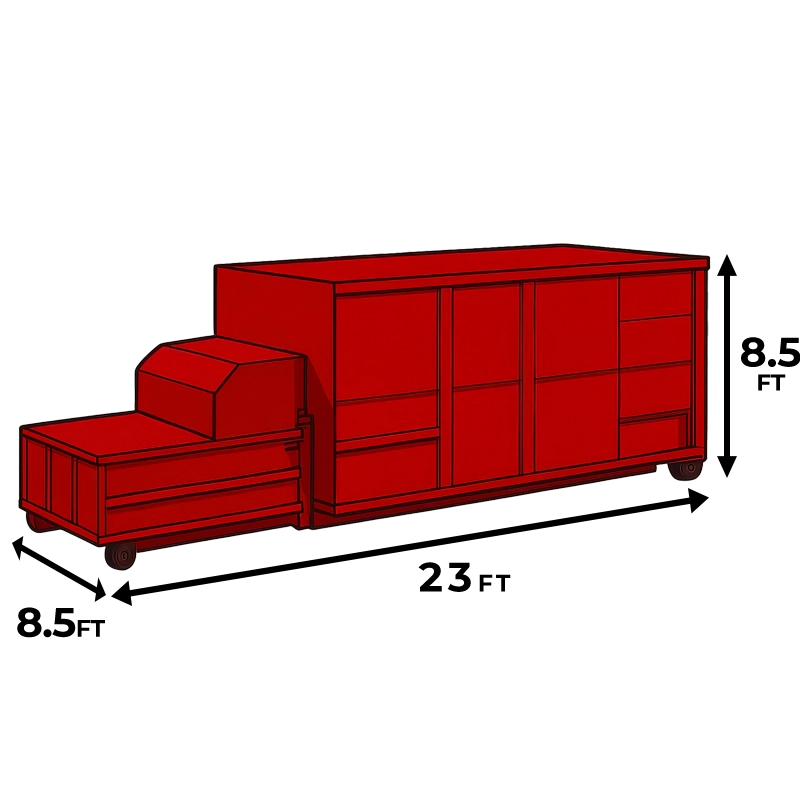
Compactor
An efficient, space-saving solution for managing high volumes of waste

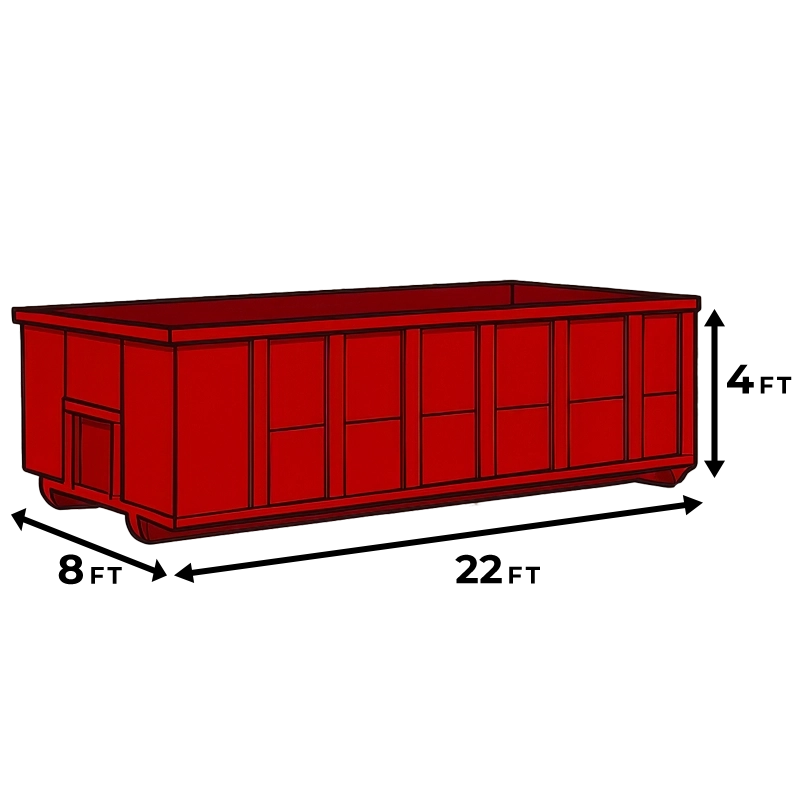
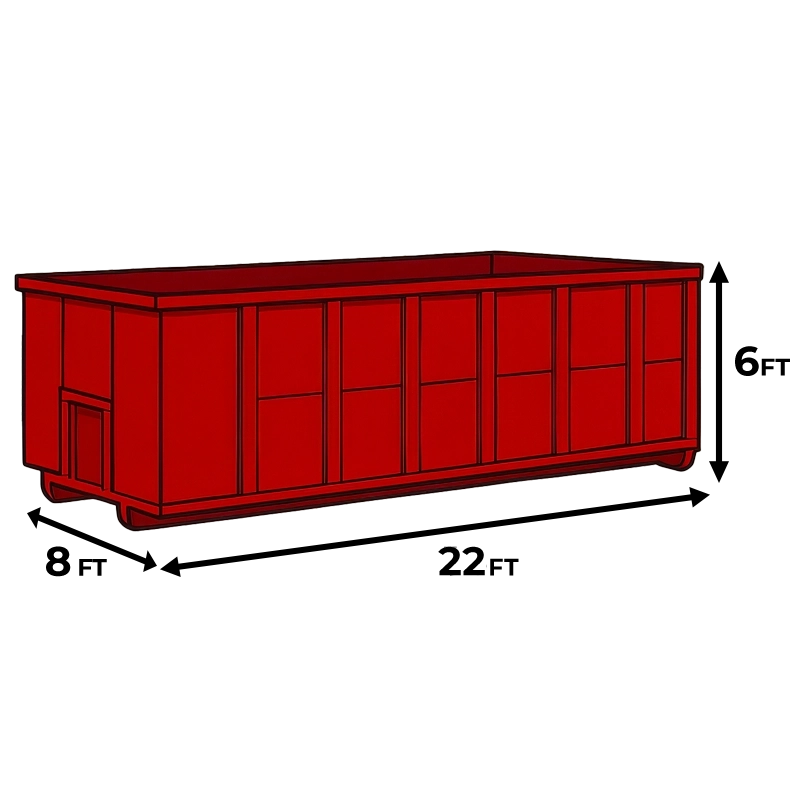
All three are 22 feet long. Only the wall height changes, which matters more than most people expect: the footprint you clear for a 20 yard is the footprint you clear for a 40, so you plan placement once and stop re-planning it every phase.

Twenty yard is the smallest container offered, and the full roll-off dumpster rental lineup sits behind these three. Longer jobs usually pair containers with portable restrooms and handwashing stations so crews are not leaving the site, and both run on the same account. Portable restroom rental

How construction waste management services work on a build

Five steps, and four of them are ours.

Call and tell us the phase

Project type, the debris you are producing, and where the container has to sit. That conversation is what sizes it correctly the first time.

We deliver and place it

Delivery needs a straight approach and clearance overhead, because the truck tilts its bed to set the container down. Low branches and power drops are the usual surprise, so walk the placement with the driver and it lands where you want it.

Your crew fills it

Non-hazardous construction and demolition debris, loaded level with the container walls so it can be tarped and hauled.

We swap it before it stops you

Call before it fills. We pick up the loaded container, set an empty one on the same spot, and the replacement is billed as its own rental.

We haul and handle disposal

End to end, with nothing for your team to arrange downstream.

Every roll-off company does steps 2, 3, and 5, and we are not going to pretend that part is a differentiator. Step 4 is where jobs are won or lost.

On lead time, five days' notice is ideal and shorter turnarounds are often accommodated depending on routing that week. Call 210-372-8666 for current availability.

Sizing for this work

Most commercial jobs change container size at least once. Heavy phases want a small container. Light phases want a big one. Say which phase you are in when you book.

Concrete, masonry, and foundation breakout

20-yard. Dense material reaches the 10 ton road limit while the container still looks half empty. A bigger container does not help, because what you run out of is weight and not space. The walls are 4 feet high, low enough to load over the side.
20-Yard

Drywall, framing offcuts, and packaging

40-yard. Light and enormous. You run out of space long before you get near the weight limit, so take the biggest container your site will fit. The walls are 8 feet high. If you fill it before the phase is done, we swap it for an empty one.
40-Yard

Mixed build-out and finish-out debris

30-yard. The default on most commercial build-outs, where sorting debris by phase is not worth the labor. The walls are 6 feet high. Tell us the load is mixed when you book, because it reaches the weight limit sooner than a drywall-only container.
30-Yard

Strip-out and selective demolition

30-yard., swapped often. Plaster and ceiling grid come out light, then the block and old fixtures behind them come out heavy. On this phase the swap schedule matters more than the size you picked.
30-Yard

Two trades producing at once usually calls for two containers instead of one bigger one. Tell us the phase and the debris type when you call and we will size it with you. Dumpster size for a renovation covers the same question for smaller scopes, and every size is listed on the dumpster sizes page.

What can and cannot go in

Everything accepted is non-hazardous.

Goes InStays Out
Concrete, brick, block, and masonryHazardous waste of any kind, including paint, solvents, oils, and chemicals
Lumber, framing offcuts, and packagingAsbestos
Metal, rebar, and conduitLiquid waste of any kind
Drywall, plaster, and lathTires
Fixtures, cabinetry, and millworkBatteries and vehicle fluids
Large equipment removed during demolitionPropane tanks

General construction and demolition debris

Medical waste

Appliances, once refrigerants have been discharged

Flammable or explosive materials

Contaminated soil and non-hazardous special waste are a separate process, with testing and documentation ahead of the haul. We handle both, under credentials that differ by material type, and neither belongs on a general construction container.

Why choose South Texas Dumpsters

We are registered for what leaves your site, and you are the one signing for it

South Texas Dumpsters carries EPA ID TXR000083663 for waste transport, and work inside San Antonio and Bexar County runs under our Solid Waste Haulers Permit, City of San Antonio. On a commercial job the general contractor is the name on the paperwork when material leaves, so the hauler's registration is your exposure, not theirs. Permits and credentials and how to verify a waste hauler's credentials.

One hauler for the whole site, including the material most will not take

Most roll-off companies cannot legally accept contaminated soil or Class 1 and Class 2 non-hazardous special waste, so the moment your site turns something up you are sourcing a second vendor mid-job. We can take both, which means one account and one point of contact even when the scope changes underneath you.

The dispatcher knows your street

We have been running these routes across South and Central Texas for over a decade, which is why the person taking your call already knows which downtown lots a roll-off truck cannot get into and which approach works instead. That is the difference between a placement conversation and a wasted delivery.

You reach a person, not a queue

Dispatch is local and the phone is answered here, not at a call center in another state. When a container has to move today because the schedule moved, that is the entire difference.

Testimonials

See what others are saying

“Booked a big ol' dumpster online, easy as pie. Arrived on demo day, clean and strong enough for all the bricks and shingles. Crew filled it fast, no overflowing mess. One call later, South Texas Dumpsters hauled it away next day, leaving my driveway spotless. No hidden fees, just fast, professional service. Saved me tons of trips to the dump and backaches."

Kyle F.

“Service has been great! It's refreshing to work with such an organized and professional group! Even when we give them last minute notice, they get us taken care of! Thanks for the flexibility and continued good communication!”

Rhiannon S.

“I would recommend. Great customer service, easy to get and on time delivery.”

Maritza G.

Happy driver man of industrial dump truck sits in cab and works on construction building site

Where we serve

Containers run out of San Antonio across Bexar County and up the I-35 corridor into Travis County, plus the Hill Country communities in between.

San Antonio is home. From there we cover Austin, New Braunfels, San Marcos, Seguin, Boerne, and Kerrville, along with the wider South Texas communities listed on the service areas page.

If your project sits outside those, call. Coverage extends further than the page list suggests.

FAQ

Construction and demolition debris: concrete, brick, block, lumber, metal, drywall, plaster, fixtures, cabinetry, and the large equipment that comes out during a strip-out. Appliances are fine once refrigerants have been discharged. Everything accepted is non-hazardous. Paint, solvents, oils, asbestos, tires, batteries, propane tanks, liquid waste, and anything flammable have to be handled separately, and putting them in a container will hold up the haul.

If the container sits on private property, which on most jobs means your own site or lot, you generally do not. If it has to sit on a public street, sidewalk, or right-of-way, the city almost always requires a permit, and requirements differ between San Antonio, Austin, and the smaller Hill Country municipalities. Check with the municipality before the delivery date. Our permits page covers what to ask for.

Containers cannot exceed 10 tons on Texas roads regardless of size, which is a DOT transport limit that applies to every hauler on the road. Weight above what your quoted rate covers is billed as overage. On demolition phases, the usual answer is to call before the container is full and swap it, which keeps every load inside the limit.

Sizing containers to the phase instead of the project, scheduling swaps so a full container never stops a trade, and putting portable sanitation on the same account for crews on longer jobs. It also means the hauling itself is properly registered, which matters when a general contractor is the one signing for what leaves the site. Waste management in construction is mostly a scheduling problem, and that is the part we take off your plate.

Four things: the container size, how long it stays on site, the type of debris going in, and where the job is. Debris type matters more than most people expect on a construction job, because weight-dense material like concrete and masonry reaches the transport limit at a fraction of the volume that framing waste does. That is also why matching the container to the phase usually costs less across a build than carrying one large container the whole way. Call 210-372-8666 and we will quote it against your actual scope.

The rental period is set when your job is quoted, and it is built around your schedule. Jobs run long, and extending or swapping is a phone call. Call 210-372-8666 before the container sits idle so the pickup can be routed with the rest of that day's runs.

Yes, and on any build longer than a couple of weeks you should plan on it. We pick up the full container, haul it for disposal, and set an empty one on the same spot. The replacement is billed as a separate rental. Schedule swaps against your phase changes and the container stops being something anyone has to think about.

Get a container sized to your build

Tell us the project, the phase, and the debris type, and we will put the right container on your site rather than the one that happens to be on the truck. Call 210-372-8666 or contact us for a quote built around your job.